Overhead cranes are vital equipment in industries where heavy lifting and precise material handling are part of everyday operations. Among the commonly used capacities, the 30-ton overhead crane strikes a balance between medium and heavy-duty applications, making it suitable for workshops, warehouses, shipyards, and fabrication yards. However, the structural design of a 30-ton overhead crane significantly varies based on its installation environment — specifically, whether it is installed indoors or outdoors. This article explores the fundamental and nuanced differences in structural design considerations for indoor vs. outdoor 30-ton overhead cranes, addressing key areas such as material selection, weather resistance, stability, foundation interface, maintenance requirements, and safety measures.
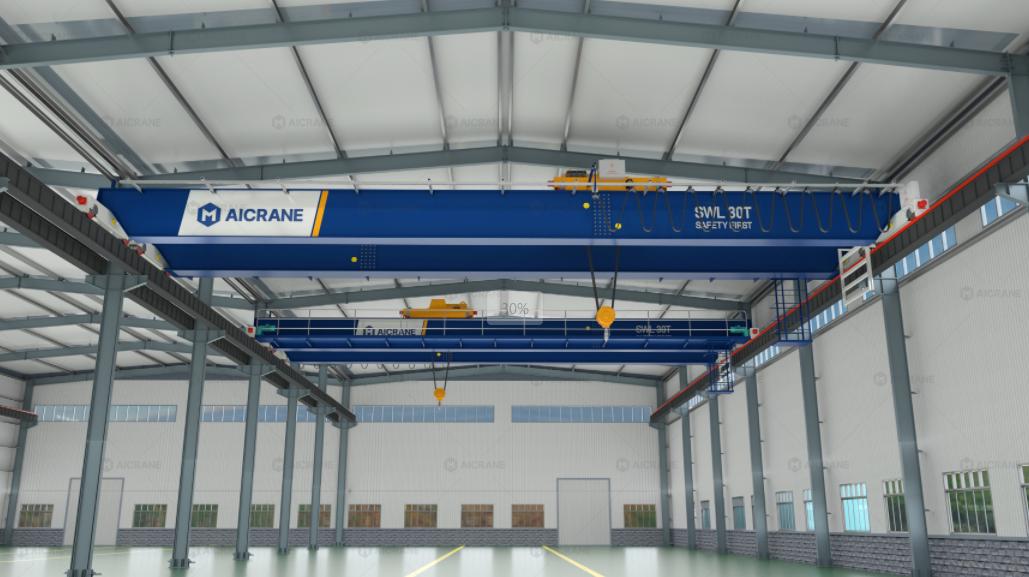
1. Basic Structural Design Overview of a 30 Ton Overhead Crane
Before diving into the environmental variations, it’s important to understand what constitutes a 30 ton overhead crane structurally. Most 30-ton cranes are:
-
Double Girder Cranes: Two bridge girders span across the runway to support the trolley and hoist, allowing for higher lifting height and greater stability.
-
Top Running: These cranes run on rails installed on top of runway beams, which is typical for heavier loads like 30 tons.
-
Heavy-Duty Hoists: Equipped with wire rope hoists or winch-type hoisting systems, capable of handling continuous or frequent-duty cycles.
These elements remain consistent across environments, but how they are constructed, coated, installed, and supported varies considerably between indoor and outdoor use.
2. Material Selection and Corrosion Protection
Indoor Cranes:
-
Indoor environments are generally controlled, with minimal exposure to moisture, temperature fluctuations, or chemical contaminants.
-
Mild steel or standard structural steel (such as Q235 or Q345 in China) is commonly used.
-
Paint coatings for indoor overhead cranes focus on aesthetic finish and basic rust prevention.
Outdoor Cranes:
-
Exposure to rain, snow, UV radiation, high humidity, or marine air necessitates enhanced corrosion protection.
-
Galvanized steel or weathering steel may be used in the fabrication of structural components.
-
Protective coatings include epoxy zinc-rich primers, polyurethane topcoats, or hot-dip galvanization for long-term rust protection.
-
Stainless steel enclosures may be used for sensitive components like electrical panels or drive systems.
Outdoor cranes must endure a harsher environment, so structural steel elements are often overdesigned for longevity and resilience.
3. Load and Wind Resistance Design
Indoor Cranes:
-
Wind loads are negligible indoors, and lateral forces are primarily due to crane acceleration and deceleration.
-
Building columns and runway girders can be more closely spaced, and bracing requirements are relatively modest.
Outdoor Cranes:
-
Outdoor cranes must account for wind loads, both operational (with a load) and parked (without load but with possible wind gusts).
-
Structural design includes wind bracing systems, stronger lateral supports, and anchoring systems to prevent crane derailment.
-
In high-wind zones, cranes are fitted with storm locks, rail clamps, and tie-downs to keep them secure when not in use.
Designing for wind loads is one of the most critical differences in outdoor cranes, especially for coastal or open-area installations.
4. Crane Runway and Support Structure
Indoor Cranes:
-
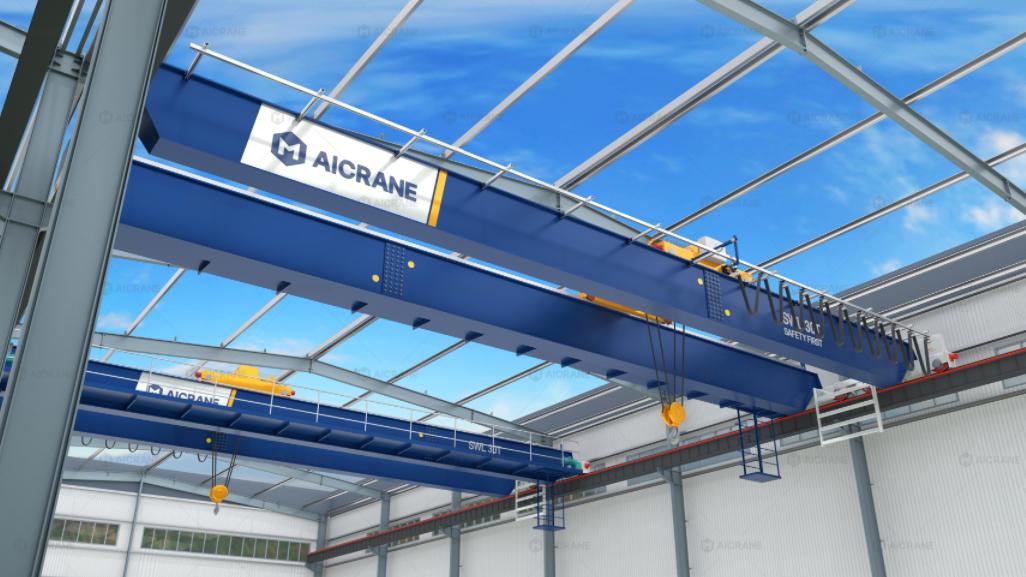
Runway beams are typically mounted on or integrated into the steel structure of the factory or warehouse.
-
The supporting columns and bracing are built into the overall building design.
-
Indoor runways benefit from a stable, temperature-controlled environment that minimizes steel expansion or contraction.
Outdoor Cranes:
-
Runways may be supported by independent steel or concrete gantry legs or towers if not connected to a building.
-
Supports must resist environmental factors, and allowances must be made for thermal expansion and contraction of the metal structures.
-
The foundation and columns are reinforced to withstand uneven ground settlement, wind-induced vibration, and seismic loads.
Outdoor installations often demand geotechnical evaluation and more complex civil engineering foundations for stability.
5. Electrical System Design Differences
Indoor Cranes:
-
Electrical components are housed in standard enclosures, with IP ratings of IP54 or IP55 typically sufficient.
-
Power is supplied via conductor bars, festoon systems, or cable reels, depending on crane span and movement.
Outdoor Cranes:
-
Electrical systems require weatherproof or waterproof enclosures with higher IP ratings (IP65 and above).
-
Electrical heaters or dehumidifiers may be added inside control boxes to prevent condensation.
-
Power supply systems must be designed to withstand UV exposure and remain functional in wet or icy conditions.
Reliable electrical system design is critical outdoors to prevent downtime and protect operators from electric hazards.
6. Maintenance Access and Serviceability
Indoor Cranes:
-
Maintenance access is more straightforward and safer due to the controlled environment.
-
Inspections and lubrication can be scheduled regularly without much weather-related delay.
Outdoor Cranes:
-
Maintenance platforms, catwalks, and ladders must be designed to withstand exposure and remain non-slip under wet conditions.
-
Lighting and access points are critical for safe nighttime or poor weather inspections.
-
Outdoor cranes may need remote condition monitoring systems to reduce manual inspection frequency.
The design must anticipate the difficulty of outdoor maintenance and allow for safe, frequent access to components.
7. Operational and Safety Features
Indoor Cranes:
-
Collision avoidance systems and warning alarms are usually sufficient.
-
Operator cabs may not be required; pendant or remote control is common.
Outdoor Cranes:
-
More robust operator cabins may be needed, equipped with climate control to protect against temperature extremes.
-
Wind speed indicators, lightning protection, and emergency shutdown systems are integrated to respond to weather threats.
-
Cranes are often fitted with limit switches, sway control, and load monitoring systems that can work in dynamic weather environments.
Outdoor crane operation demands enhanced safety due to unpredictable external variables.
8. Cost Implications and Project Planning
The cost of outdoor 30-ton overhead cranes is generally higher than indoor cranes due to:
-
Additional materials for corrosion resistance
-
Reinforced structures for wind and weather loading
-
Higher-specification electrical components
-
Civil work and foundations for open-area installation
Project planning must also include longer lead times for fabrication, coating, and weather contingency for installation.
Conclusion: Environment Dictates Engineering
While indoor and outdoor 30-ton overhead cranes may perform similar lifting tasks, the structural design between the two varies widely due to environmental factors. Indoor cranes benefit from controlled conditions and can rely on integrated structural supports. Outdoor cranes, by contrast, must be engineered for survival — resisting wind, rain, UV, and wide temperature fluctuations.
Aicrane engineers tailor every 30-ton overhead crane to its operational environment, ensuring structural integrity, long service life, and safety in every lift. Whether you’re outfitting a steel workshop or an open-air fabrication yard, understanding and planning for these design differences is essential for successful crane deployment.
Leave a Reply