When planning and constructing a steel structure warehouse, one of the most important design considerations is the type of overhead crane that will be installed. Overhead cranes are integral to material handling in industrial facilities, enabling the movement of heavy loads efficiently and safely across large areas. However, not all cranes are the same—different crane types, such as single girder, double girder, and suspension cranes, impose distinct requirements on the warehouse structure. Understanding how the crane type influences key design parameters—such as span, height, column spacing, runway beams, and foundation loads—is crucial for ensuring both operational efficiency and structural safety.
1. Understanding the Relationship Between Crane Type and Building Design
The integration of an overhead crane into a steel structure warehouse must be considered from the very beginning of the design process. The crane’s load capacity, operating class, span, and lifting height all affect the geometry and strength of the steel structure.
Each crane type interacts differently with the warehouse frame:
-
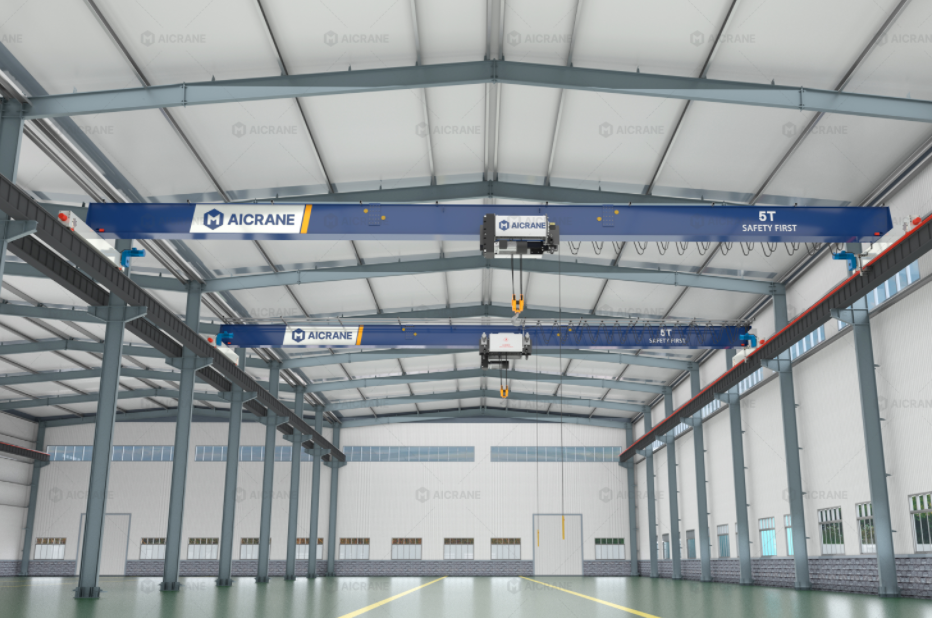
Single girder overhead cranes are lighter and typically require less structural reinforcement.
-
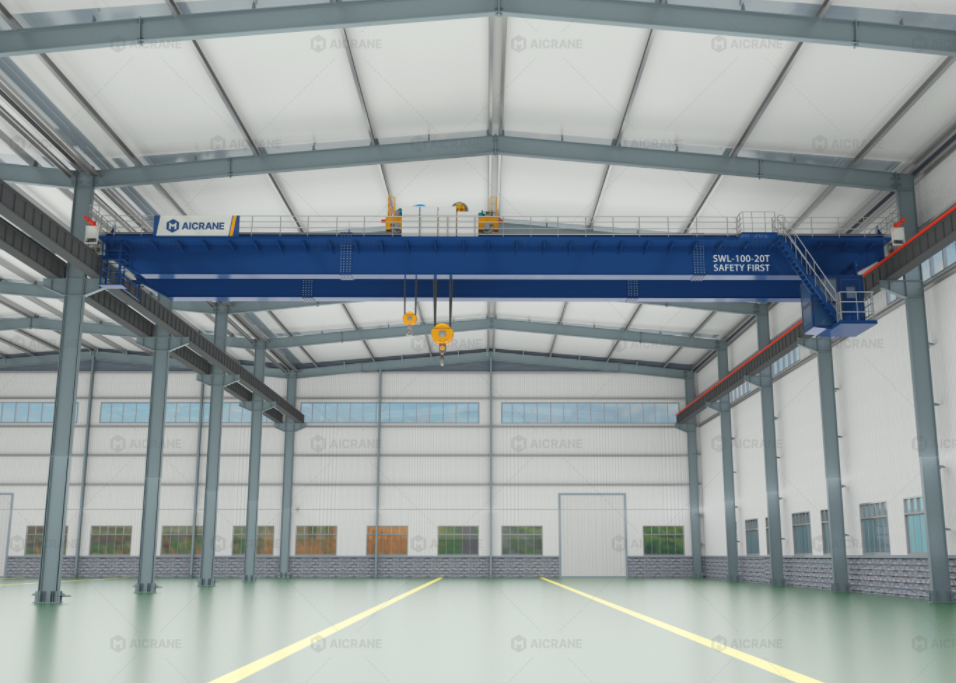
Double girder overhead cranes can handle heavier loads and longer spans, thus demanding stronger runway beams and columns.
-
Suspension cranes are supported directly from the roof structure, influencing truss design and roof loading capacity.
Therefore, selecting the right crane type early in the planning stage allows the structural designer to optimize the warehouse’s frame layout, minimize steel consumption, and ensure long-term performance.
2. Structural Loads and Support Requirements
One of the most direct influences of crane type on warehouse design is the load distribution. The total load a building must bear includes not only the crane’s self-weight but also the weight of the hoist, trolley, and lifted materials.
-
Single girder cranes exert moderate loads through one main beam and end trucks. The vertical load is transferred via the crane runway beam to the supporting columns. Since these cranes usually have lower lifting capacities (1–20 tons), they require lighter runway beams and smaller column sections.
-
Double girder cranes, which can lift up to several hundred tons, impose much higher loads. Their dual girders and heavier trolleys require reinforced crane girders, larger columns, and stronger foundations.
-
Suspension cranes (or underhung cranes) do not require floor-mounted runway beams. Instead, they hang from the roof trusses, transferring dynamic loads directly to the roof structure. This demands robust roof bracing and precise load path calculations to avoid excessive deflection or vibration.
Thus, the type of overhead crane determines the size and material grade of runway beams, column profiles, and bracing system required to maintain structural integrity.
3. Influence on Warehouse Span and Column Spacing
Crane span refers to the distance between the centerlines of the runway rails. The type of overhead crane significantly impacts both the span of the crane itself and the corresponding spacing of the warehouse columns.
-
Single girder cranes are suitable for smaller spans (usually up to 25 meters) and light-duty operations. The columns can be spaced closer together, resulting in more economical steel use.
-
Double girder cranes can achieve longer spans—often exceeding 30 meters—allowing larger unobstructed working areas. However, this increases the bending moments on runway beams and the spacing between columns must be carefully optimized to balance structural efficiency and cost.
-
Suspension cranes, being roof-supported, allow for completely column-free interiors, ideal for warehouses requiring open floor space. The design challenge lies in ensuring the roof truss system is capable of supporting both vertical and lateral crane loads.
In summary, selecting a heavy-duty double girder bridge crane typically means the building must accommodate wider spans and heavier structural elements, while a light-duty single girder or suspension crane allows for simpler, lighter steel frameworks.
4. Impact on Building Height and Clearances
The lifting height and hook travel of an overhead crane directly affect the warehouse’s vertical dimensions.
-
Single girder cranes have a lower profile since the hoist is suspended beneath the main beam. Therefore, the building can have a relatively low height while maintaining sufficient headroom for operations.
-
Double girder cranes place the hoist between the two girders, allowing higher lifting heights but requiring more vertical space for the crane structure and maintenance access. This increases the overall building height and the cost of steel columns and wall cladding.
-
Suspension cranes usually have the most compact design, suitable for facilities with limited headroom or height restrictions.
Additionally, maintenance platforms, walkways, and electrical festoon systems must be accounted for in the vertical clearance design. A mismatch between crane dimensions and building height can lead to operational inefficiencies or even safety hazards.
5. Runway Beam and Rail Design
The runway system—including beams, rails, and supporting brackets—is a key interface between the crane and the building structure. Different crane types have distinct runway design requirements.
-
Single girder cranes use lighter runway beams, often with a square rail or an integrated I-beam track.
-
Double girder cranes require larger box-type runway beams or independent girder beams with robust rail anchorage systems.
-
Suspension cranes run on bottom flanges of roof beams or special tracks fixed to roof trusses. The roof structure must be designed to prevent torsion and excessive lateral movement.
Proper alignment and stiffness of runway beams are essential to avoid rail misalignment, wheel wear, and vibration. The building’s columns must provide sufficient lateral restraint to the runway beams to maintain geometric accuracy under dynamic loading.
6. Foundation and Vibration Considerations
The foundation design of a steel structure warehouse is closely linked to the crane’s operating characteristics. Heavy-duty cranes such as double girder types with large lifting capacities generate significant vertical and horizontal forces. These forces are transmitted through the columns into the foundation.
To mitigate vibration and settlement:
-
Heavier cranes may require reinforced concrete pedestals or isolated column footings.
-
Lighter single girder or suspension cranes can rely on standard spread foundations.
-
Dynamic load analysis must be performed to assess how the crane’s acceleration and braking affect the building’s structural response.
Neglecting this interaction can result in excessive deflection, uneven settlements, and premature wear of crane components.
7. Roof and Bracing System Design
For suspension cranes or buildings housing multiple cranes, the roof structure must be carefully analyzed for combined loading effects. The top bracing system plays a critical role in stabilizing the warehouse frame against horizontal loads from crane motion.
In single and double girder crane warehouses, cross bracing or portal bracing between columns enhances lateral stability. For suspension cranes, roof trusses often require additional gusset plates and stiffeners to resist dynamic load transfer from the crane.
8. Conclusion: Integrating Crane Selection into Early Warehouse Design
The type of overhead crane chosen for a steel structure warehouse is far more than a mechanical equipment decision—it fundamentally shapes the building’s architectural and structural parameters.
Single girder cranes are ideal for light-duty warehouses where economy and simplicity are priorities. Double girder cranes suit heavy industrial environments demanding long spans and high lifting capacities, but they require a stronger, taller, and more expensive steel structure. Suspension cranes offer flexible installation in small or height-limited buildings, with careful attention to roof load distribution.
Ultimately, early coordination between the crane supplier and the steel structure designer ensures that the warehouse layout, column grid, runway beams, and foundation are all optimized for the specific crane system. This integrated approach not only guarantees safety and performance but also minimizes construction and maintenance costs over the life of the facility.
Leave a Reply