When engineers, buyers, and operations managers evaluate a double girder gantry crane, they often focus immediately on its rated capacity—20 tons, 50 tons, 100 tons, or more. However, lifting capacity alone does not fully define a crane’s performance. One of the most critical yet frequently overlooked factors is the duty cycle, also known as work duty or crane classification, commonly expressed as A3 to A8 under international crane standards such as FEM, ISO, and CMAA equivalents.
For double girder gantry cranes used in steel yards, precast concrete plants, railway loading yards, shipyards, and fabrication workshops, the duty cycle fundamentally determines how much stress the crane endures and how its capacity performance should be interpreted. In other words: two cranes with the same lifting capacity can perform completely differently depending on their duty cycle.
This article explains how the duty cycle affects double girder gantry crane capacity, why it matters for structural and mechanical design, and how choosing the right duty classification ensures long-term reliability and safety in demanding industrial environments.
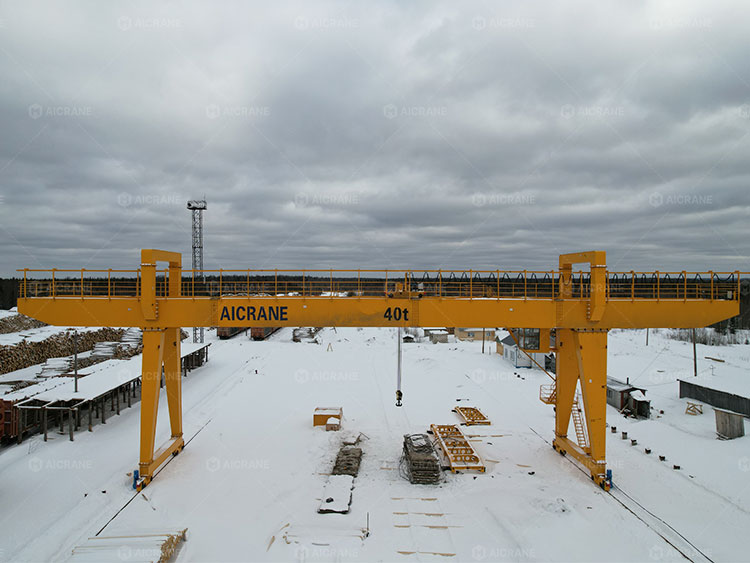
Understanding Duty Cycle (A3–A8)
The duty cycle classification reflects how intensively a crane will be used. It is defined based on:
-
Load spectrum: the percentage of rated load handled during actual operations
-
Number of cycles: how many lifting cycles per hour and per year
-
Operating environment: continuous or intermittent operation
-
Fatigue level: expected stress cycles over the crane’s lifetime
The general definitions are:
-
A3–A4: Light to Medium Duty
Suitable for maintenance, light workshops, occasional lifts. -
A5–A6: Heavy Duty
Ideal for manufacturing, assembly lines, logistics yards, steel mills, precast plants. -
A7–A8: Severe Duty / Continuous Production
Required for shipyards, container terminals, mining operations, and 24/7 industrial use.
Double girder gantry cranes commonly operate in the A5–A6 range, though heavy container-handling or steel mill cranes may require A7–A8.
Why Duty Cycle Directly Influences Crane Capacity
1. Rated Capacity Is Based on Duty Class, Not Just Load Weight
A gantry crane’s rated capacity (e.g., 30 tons or 50 tons) is tested and certified within the assumptions of its duty class.
For example, a 50 ton gantry crane rated as A4 is not equivalent to a 50-ton crane rated as A7.
-
The A4 crane assumes occasional heavy lifts and a moderate number of cycles.
-
The A7 crane assumes frequent heavy lifts, near-maximum loading, long operating hours, and continuous stress cycles.
Thus, duty cycle determines how often and how long the crane can safely perform its rated capacity without excessive wear, overheating, or structural fatigue.
2. Structural Strength Requirements Vary by Duty Class
A double girder gantry crane’s structure—including girders, end carriages, legs, rail connections, and supporting steel members—must resist fatigue over thousands or millions of cycles.
Higher duty class means:
-
Higher stress-cycle resistance
-
Stronger steel sections
-
Larger girder profiles
-
Increased weld thickness and weld length
-
More reinforcement at high-stress areas
-
Enhanced stiffness for reduced deflection under repeated loads
For example:
-
An A5 crane might have girders sized for moderate cycle fatigue.
-
An A7 crane requires significantly thicker and stronger beams to survive continuous heavy loading.
Therefore, capacity in real-world use is inseparable from duty class, because heavy-duty cranes maintain their rated capacity through years of operation without premature structural failure.
3. Mechanical Components Are Sized According to Duty Cycle
The mechanical parts of a double girder gantry crane face the most intense wear in high-duty applications. Duty cycle significantly impacts the design and capacity rating of:
Hoist and Trolley Mechanisms
-
Larger motor power for continuous operation
-
Stronger gearbox with higher duty cycle efficiency
-
Heat-resistant brakes and higher braking frequency
-
Reinforced rope drums
-
Higher-grade wire ropes or reeving system
Travel Motors and Wheels
-
More powerful and thermally efficient motors
-
Hardened wheels for long rolling life under heavy loads
-
Geared couplings designed for more operating hours
Braking System
-
Higher allowable braking cycles
-
Redundant or dual-disc brakes in A7–A8 cranes
Thus, the mechanical capacity of the crane to sustain repeated lifting operations is defined by duty class.
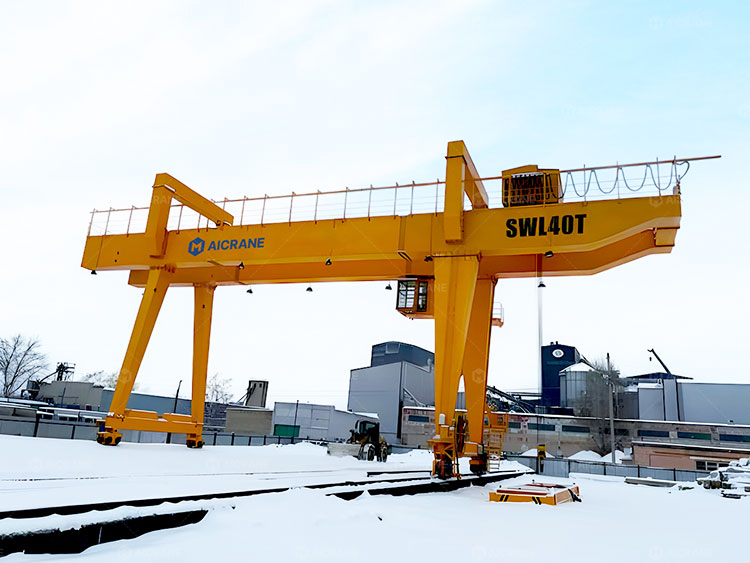
4. Duty Cycle Defines Heat Limits and Thermal Capacity
In higher duty applications, motors, brakes, and electrical systems operate more continuously and generate more heat.
Duty cycle determines:
-
Thermal class of motors
-
Requirement for continuous-duty rating
-
Cooling systems (e.g., fan-cooled motors, larger enclosures)
-
Capacities of electrical inverters and control systems
Therefore, even if a crane can physically lift 50 tons, it may not do so continuously without overheating unless it is designed for A7–A8 duty.
5. Fatigue Life of the Crane Depends on Duty Cycle
Crane fatigue is cumulative. A crane working at high frequency with high load spectrum reaches its fatigue limit faster.
Duty cycle standards ensure that the crane’s structural and mechanical components are designed for the required fatigue life.
This means:
-
A3 cranes may be suitable for occasional loading in workshops.
-
A6 cranes can endure years of continuous industrial operations.
-
A8 cranes support the highest cycle requirements, such as container terminals with nonstop shifts.
Thus, the effective long-term capacity is heavily determined by duty cycle.
6. Cost, Weight, and Size Are Tied to Duty Class
Higher duty cranes are significantly more robust, heavier, and more expensive than lower duty cranes of the same nominal capacity.
For example, comparing two 50-ton double girder gantry cranes:
-
A4 crane: lighter girders, smaller trolley, lower power motors
-
A7 crane: heavier structure, larger wheels, more powerful drives, reinforced hoist frame, thicker flanges
This means buyers must consider actual operational needs rather than simply choosing by lifting capacity.
7. Duty Cycle Helps Prevent Undersized Crane Selection
Selecting a crane based only on lifting capacity can lead to:
-
Frequent breakdowns
-
Overheating
-
Brake wear
-
Structural cracking
-
Shortened lifespan
Duty cycle ensures the crane is correctly sized for actual usage intensity rather than merely for weight requirements.
Practical Examples of Duty Cycle Impact on Capacity
Example 1: Precast Concrete Yard – A6 Required
A 30-ton gantry crane lifting concrete beams hourly must withstand:
-
High cycle frequency
-
Heavy load spectrum
-
Long operating periods
Although A5 might seem sufficient, A6 ensures long-term reliability.
Example 2: Railway Loading Station – A5
A 20–50 ton double girder gantry crane loading steel coils or containers periodically throughout the day requires:
-
Medium to heavy cycle classification
-
Longer running distances and continuous travel motion
A5 is often appropriate.
Example 3: Steel Mill – A7–A8
Cranes used in high-temperature, 24/7 production must be designed for:
-
Very frequent lifting
-
High fatigue stress
-
Maximum reliability
Here, duty cycle directly affects safe lifting capacity and lifetime.
Conclusion: Duty Cycle Is Central to Accurate Crane Capacity Selection
The duty cycle (A3–A8) is one of the most critical factors determining the real-world capacity, performance, and lifetime of a double girder gantry crane. Even when two cranes share the same rated capacity, their actual ability to perform under continuous industrial conditions can differ dramatically depending on their duty class.
Understanding duty cycle allows buyers and engineers to:
-
Select the correct crane for actual usage intensity
-
Avoid undersized or overworked equipment
-
Ensure safe lifting under industrial conditions
-
Achieve long-term reliability and reduced maintenance
-
Optimize investment by choosing the most appropriate design
By evaluating both rated lifting capacity and duty cycle, users can ensure their double girder gantry cranes operate safely, efficiently, and cost-effectively throughout their intended lifespan.
Leave a Reply