Rubber Tyred Gantry (RTG) cranes are a cornerstone of modern container terminals, precast yards, steel yards, and logistics hubs. As operational demands evolve toward higher flexibility, tighter yards, and complex material flow, multi-steering RTG cranes—capable of straight travel, diagonal movement, crab steering, and pivot steering—have become increasingly important.
Behind this operational flexibility lies a highly demanding structural design challenge. Unlike conventional RTGs that mainly travel in straight lines, multi-steering RTGs introduce complex load paths, torsional stresses, and dynamic forces that must be carefully managed through advanced structural engineering.
This article provides a comprehensive overview of the structural design principles, challenges, and solutions for multi-steering rubber tyred gantry cranes, focusing on safety, durability, and performance under diverse steering modes.
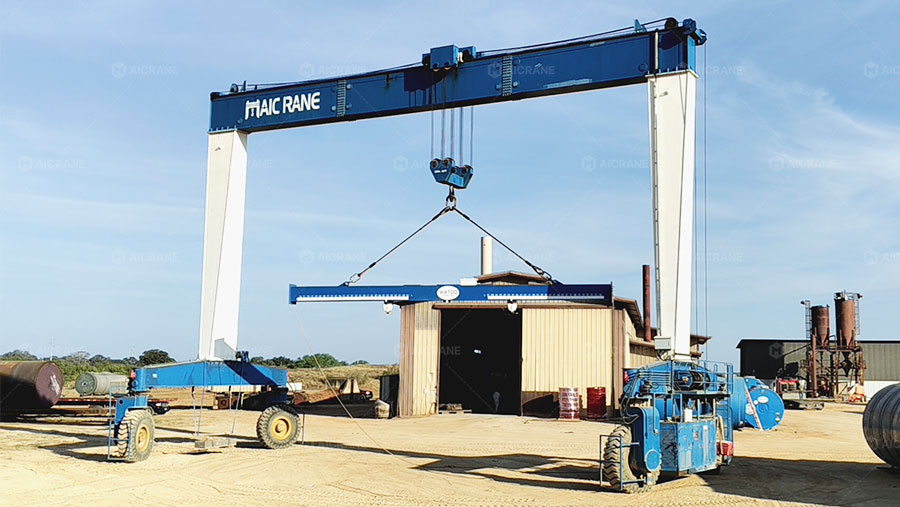
1. Why Multi-Steering Changes Structural Design Fundamentals
Traditional RTG cranes are primarily designed for longitudinal travel along container stacks. Loads are transferred vertically through the gantry legs to the wheels with relatively predictable stress distribution.
Multi-steering RTGs, however, operate under non-linear movement patterns, including:
-
Diagonal travel for flexible yard alignment
-
Crab steering for lateral positioning without rotating the crane
-
Pivot or zero-radius steering for tight maneuvering
-
Combined steering modes under partial load conditions
Each of these movements introduces horizontal forces, torsional moments, and asymmetric wheel loading, which significantly affect structural design.
Key structural impacts include:
-
Increased torsion in the gantry frame
-
Uneven stress distribution between legs
-
Dynamic fatigue from frequent steering transitions
-
Higher demands on joint rigidity and structural continuity
As a result, multi-steering RTG cranes require a more advanced and holistic structural design approach than conventional models.
2. Overall Structural Layout of Multi-Steering RTGs
2.1 Gantry Frame Configuration
The core structure of an RTG crane consists of:
-
Main girders
-
End beams
-
Rigid or semi-rigid legs
-
Portal bracing systems
For multi-steering RTGs, the gantry frame must balance global rigidity with controlled flexibility. Excessive stiffness may transfer high stress to local components, while insufficient stiffness can lead to deformation, misalignment, or fatigue cracking.
Design priorities include:
-
High torsional stiffness of the main girder
-
Symmetrical load transfer paths
-
Minimized eccentric loading during steering
Box-type welded girders are commonly adopted to enhance torsional resistance while keeping weight under control.
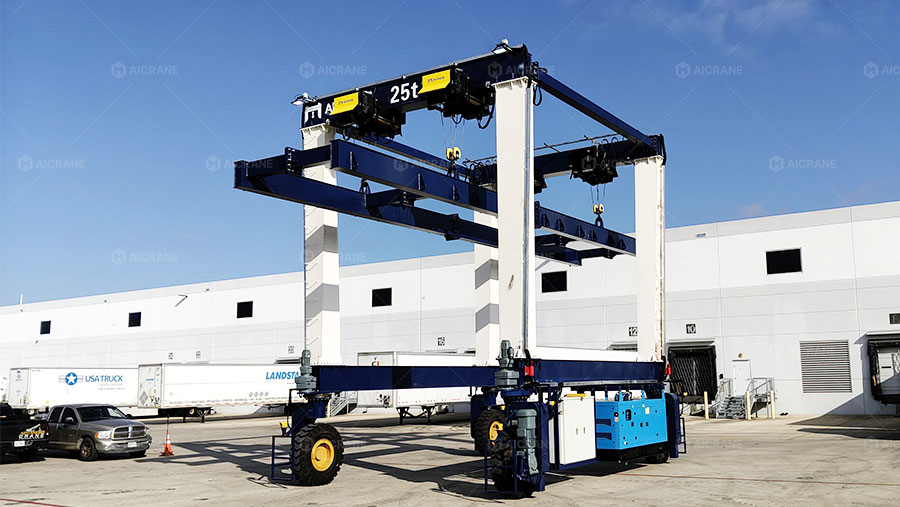
3. Structural Challenges Introduced by Multi-Steering Systems
3.1 Torsional Loads During Crab and Diagonal Steering
When an RTG moves sideways or diagonally, wheel forces no longer align with the crane’s longitudinal axis. This causes torsional moments around the vertical axis of the structure.
Structural consequences include:
-
Twisting of the main girder
-
Differential displacement between legs
-
Increased stress at welded joints and connections
To address this, designers must:
-
Increase torsional rigidity of girders
-
Optimize bracing geometry
-
Reinforce high-stress transition zones
3.2 Asymmetric Wheel Load Distribution
Multi-steering modes can lead to uneven wheel loading, especially during:
-
Turning under load
-
Acceleration and braking while steering
-
Operation on uneven ground
Structural design must account for:
-
Higher localized stresses at wheel supports
-
Increased bending moments in legs and end beams
-
Dynamic amplification factors
Finite Element Analysis (FEA) is essential to simulate these complex load scenarios and ensure structural integrity under worst-case conditions.
4. Main Girder Structural Design
4.1 Girder Cross-Section Optimization
The main girder is the primary load-bearing component. For multi-steering RTGs, its design must satisfy:
-
Vertical bending from lifted loads
-
Horizontal bending from travel and steering
-
Torsional loading from crab and diagonal movement
Closed box sections are preferred due to their superior torsional resistance compared to I-beam or open sections.
Design considerations include:
-
Wall thickness optimization
-
Internal diaphragms to control warping
-
Smooth stress transitions to avoid fatigue concentration
4.2 Fatigue-Resistant Design
Multi-steering operation increases the number of load cycles and stress reversals. Structural fatigue becomes a critical design factor.
Fatigue mitigation strategies include:
-
Continuous welds with smooth profiles
-
Avoidance of sharp geometric transitions
-
Reinforcement of high-cycle zones such as girder-leg junctions
Compliance with international standards such as FEM, ISO, or EN fatigue classifications is essential.
5. Gantry Legs and End Beam Design
5.1 Leg Structure and Stability
RTG legs serve as the main load transfer path to the wheels. In multi-steering mobile gantry cranes, legs must withstand:
-
Vertical compression
-
Horizontal shear forces
-
Bending and torsion during turning
Design approaches include:
-
Box-type leg sections for multi-directional strength
-
Reinforced corner nodes at leg-girder connections
-
Increased safety margins against buckling
5.2 End Beam and Wheel Support Design
End beams experience complex loading due to:
-
Steering-induced lateral forces
-
Uneven wheel pressure
-
Dynamic braking loads
Structural solutions include:
-
Reinforced wheel mounting plates
-
Stiffened end beam boxes
-
High-strength bolted or welded connections
These measures ensure accurate wheel alignment and long-term operational stability.
6. Structural Integration with Steering and Drive Systems
6.1 Steering Mechanism Load Transfer
Multi-steering RTGs rely on:
-
Hydraulic or electric steering actuators
-
Linkages integrated into wheel assemblies
The crane structure must:
-
Provide rigid mounting points
-
Prevent local deformation under steering forces
-
Isolate vibration from sensitive components
Reinforced brackets and localized structural thickening are commonly used in steering connection zones.
6.2 Structural Accommodation for Control Precision
High-precision steering requires:
-
Minimal structural deflection
-
Controlled elastic deformation
Excessive flexing can lead to:
-
Steering lag
-
Uneven wheel angles
-
Increased tire wear
Therefore, structural stiffness must be carefully matched to steering system responsiveness.
7. Ground Conditions and Structural Adaptability
Multi-steering RTGs often operate in:
-
Yards with uneven pavement
-
Temporary construction sites
-
Mixed surface conditions
Structural design must account for:
-
Differential settlement
-
Wheel lift scenarios
-
Load redistribution during steering
This is addressed through:
-
Increased structural redundancy
-
Conservative design load combinations
-
Enhanced safety factors
8. Low-Temperature and Harsh Environment Considerations
For RTGs operating in cold regions or harsh environments, structural design must also consider material performance.
Key measures include:
-
Use of low-temperature structural steel (e.g., Q355E)
-
Enhanced fracture toughness
-
Crack propagation control
These factors are particularly critical in multi-steering cranes due to higher dynamic stress levels.
9. Role of Finite Element Analysis in Structural Design
Modern multi-steering RTG design relies heavily on advanced simulation tools.
FEA is used to:
-
Model complex steering load cases
-
Analyze torsional and fatigue behavior
-
Optimize material distribution
Typical simulations include:
-
Straight travel under full load
-
Crab steering with offset load
-
Pivot turning under partial load
-
Emergency braking during diagonal movement
Only through comprehensive simulation can designers ensure both safety and efficiency.
10. Conclusion
The structural design of multi-steering rubber tyred gantry cranes represents a significant evolution in crane engineering. As operational flexibility becomes a critical requirement in modern logistics and industrial yards, the structure must support complex movements without compromising safety, durability, or precision.
Key takeaways include:
-
Multi-steering introduces complex torsional and dynamic loads
-
Structural rigidity and fatigue resistance are essential
-
Main girders, legs, and end beams require optimized box-type designs
-
Integration with steering systems must be structurally robust
-
Advanced FEA and conservative design principles are indispensable
A well-designed multi-steering RTG crane structure not only enhances maneuverability but also ensures long service life, reduced maintenance, and reliable performance in demanding environments.
Leave a Reply