Electric Overhead Travelling (EOT) cranes are widely used across industries for their ability to handle heavy materials with precision and reliability. In advanced applications, EOT cranes may be equipped with a rotating hoist or slewing mechanism, offering greater flexibility in load positioning and orientation. These features, however, introduce new structural and mechanical challenges that must be carefully addressed during the design phase.
This article explores the key structural design considerations for EOT cranes with rotating hoist or slewing mechanisms, including their functionality, load implications, support structures, and integration within industrial facilities.
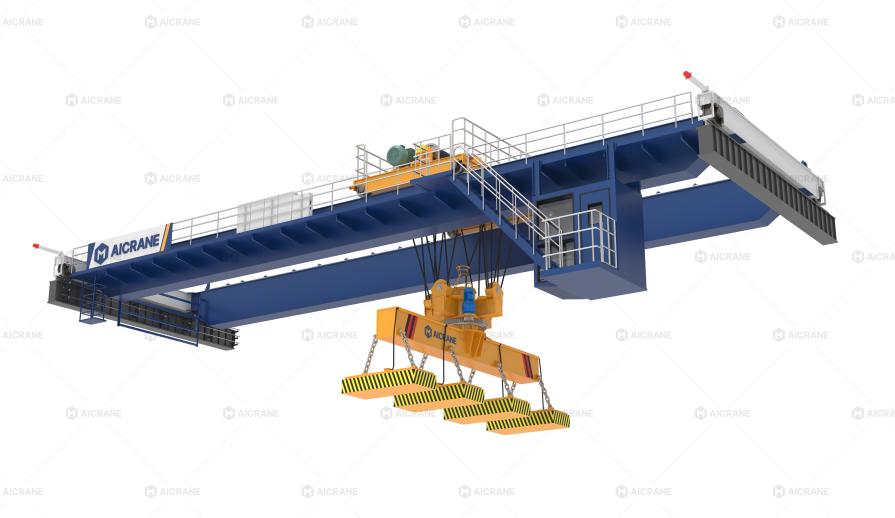
1. Understanding Rotating Hoist and Slewing Mechanisms
Before diving into structural aspects, it is essential to understand the role of rotating and slewing systems in electric overhead travelling cranes:
-
Rotating Hoist: A hoist mechanism that can rotate the lifted load along a vertical axis, often through a rotating hook or gearbox. It allows operators to precisely position and orient loads without moving the entire crane bridge or trolley.
-
Slewing Mechanism: Typically integrated into the crane trolley or bridge, it allows the hoist or an entire segment of the crane to pivot, either through a slewing ring or bearing assembly. This system is common in jib cranes and portal cranes, but advanced EOT cranes may also incorporate it.
These mechanisms are used in applications such as:
-
Assembly lines requiring load reorientation
-
Precise placement of cylindrical or asymmetric parts
-
Handling of components in confined spaces
2. Structural Design Considerations: General Overview
EOT cranes with slewing or rotating hoist functions involve dynamic forces and moments that differ from conventional crane systems. The structural design must accommodate:
-
Torsional moments due to rotating masses
-
Eccentric loading when loads are rotated off-center
-
Increased lateral and longitudinal forces due to slewing
-
High-precision alignments for bearing assemblies
The crane structure must be robust enough to resist these additional loads without compromising safety, service life, or accuracy.
3. Design of Crane Girder and Trolley Frame
a. Torsional Rigidity
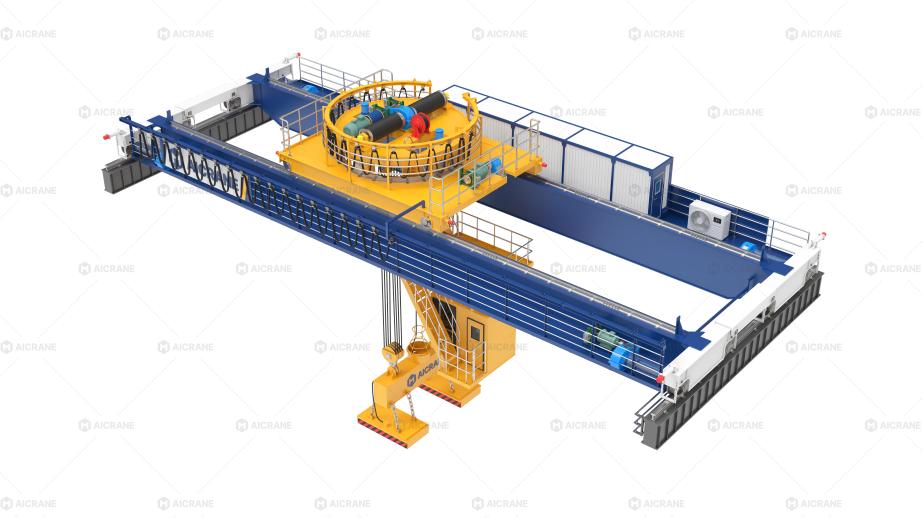
In a standard EOT overhead crane for sale, the bridge girder primarily deals with vertical bending. However, a rotating hoist introduces torsional loading due to eccentric rotation of the load. This requires:
-
Use of box girders or I-beams with torsional reinforcements
-
Additional diagonal bracings or stiffeners
-
Finite element analysis (FEA) to predict deformation under dynamic rotation
b. Reinforced Trolley Frame
The trolley frame, which carries the rotating hoist or slewing gear, must withstand:
-
Radial and axial forces from the slewing bearing
-
Vibrations and dynamic impacts during rotation
-
Load imbalances caused by off-center rotation
Reinforced trolley structures with welded box-type construction are preferred to handle these loads.
4. Slewing Ring or Bearing Integration
The slewing bearing is one of the most critical components in rotating hoist systems. Structurally, its housing and mounting area must be:
-
Flat and aligned to prevent uneven wear
-
High in rigidity to resist tilting or bending
-
Properly bolted and torque-controlled to maintain structural integrity
Often, designers add a steel base plate and bearing support ribs to distribute loads uniformly across the trolley.
5. Rotational Torque and Counterforces
When a load rotates, especially with a slewing mechanism, it creates torque reactions that transfer into the crane’s structural system. The design must account for:
-
Resisting torque through structural braces or counterweights
-
Bearing block reinforcements
-
Anti-rotation devices or locking systems for stability when idle
Additionally, torsional impact from sudden stops or emergency braking should be modeled during load simulations.
6. Runway Beam and Crane Rail Alignment
The runway beams supporting the crane must be designed for not only vertical wheel loads but also horizontal thrust caused by:
-
Slewing or rotating loads shifting the center of gravity
-
Braking or acceleration torque from the rotating mechanism
This requires:
-
Robust crane runway beams with lateral bracing
-
High-strength rail clips and bolts
-
Checking deflection limits under combined loading scenarios
Improper alignment could lead to rail deformation, increased wheel wear, or derailment.
7. Support Columns and Building Integration
When installing rotating hoist EOT cranes in steel structure buildings, the support columns and overall building frame must be assessed for:
-
Dynamic side loads
-
Asymmetric loading scenarios
-
Fatigue due to frequent rotation and torsion
In many cases, column stiffeners or additional bracing systems are added to improve stability. Coordination with building engineers is critical to ensure compatibility with the crane design.
8. Motor, Gearbox, and Control Systems Placement
The weight and location of the motor and gearbox for the slewing mechanism can shift the load center on the trolley or bridge. Structurally:
-
Their weight must be included in dead load calculations
-
Vibration dampening pads or base mounts may be required
-
Access platforms or maintenance walkways should be structurally supported
Electrical cables, festoon systems, and rotating joints must also be protected from bending stresses during rotation.
9. Dynamic Analysis and Simulation
Advanced structural design must include:
-
Finite Element Analysis (FEA) to simulate stresses under slewing and rotation
-
Dynamic modeling to analyze how the crane structure responds to rotating loads, braking forces, and resonance
-
Fatigue life analysis for components experiencing repeated rotation and torque
This ensures the crane meets both safety standards and long-term durability expectations.
10. Safety and Compliance Standards
Cranes with rotating mechanisms must meet additional safety and design standards, such as:
-
ISO 8686: Design loads for cranes
-
FEM 1.001: Classification of mechanisms
-
ASME B30.2: Overhead and gantry cranes
-
EN 13001: General design for cranes
Safety devices must be integrated, including:
-
Slew angle limiters
-
Overload protection
-
Emergency stop for slewing
-
Anti-collision sensors
11. Maintenance and Accessibility
The structural design should also consider ease of maintenance, including:
-
Platforms or ladders for accessing slewing gears
-
Removable covers for inspection of rotating components
-
Support beams for handling or replacing the slewing motor or bearings
Designing with maintenance in mind reduces downtime and improves operational safety.
Conclusion
Designing the structure of an EOT crane with a rotating hoist or slewing mechanism involves more than just scaling up standard crane designs. It demands a detailed analysis of torsional forces, dynamic loading, structural reinforcements, and mechanical precision. Each component—from the girder and trolley to the building support—must work in harmony to ensure the crane operates safely and effectively under all conditions.
With the help of modern simulation tools, compliance standards, and experienced engineering teams, it is possible to integrate slewing and rotating capabilities into overhead cranes without compromising safety or performance. These advanced EOT crane systems enable more versatile material handling operations and play a crucial role in industries where precision and flexibility are paramount.
Leave a Reply